
Mazaya Blog Where the Future is Made
Dynamics 365 for Retail: Connecting Finance, Inventory and Supply Chain
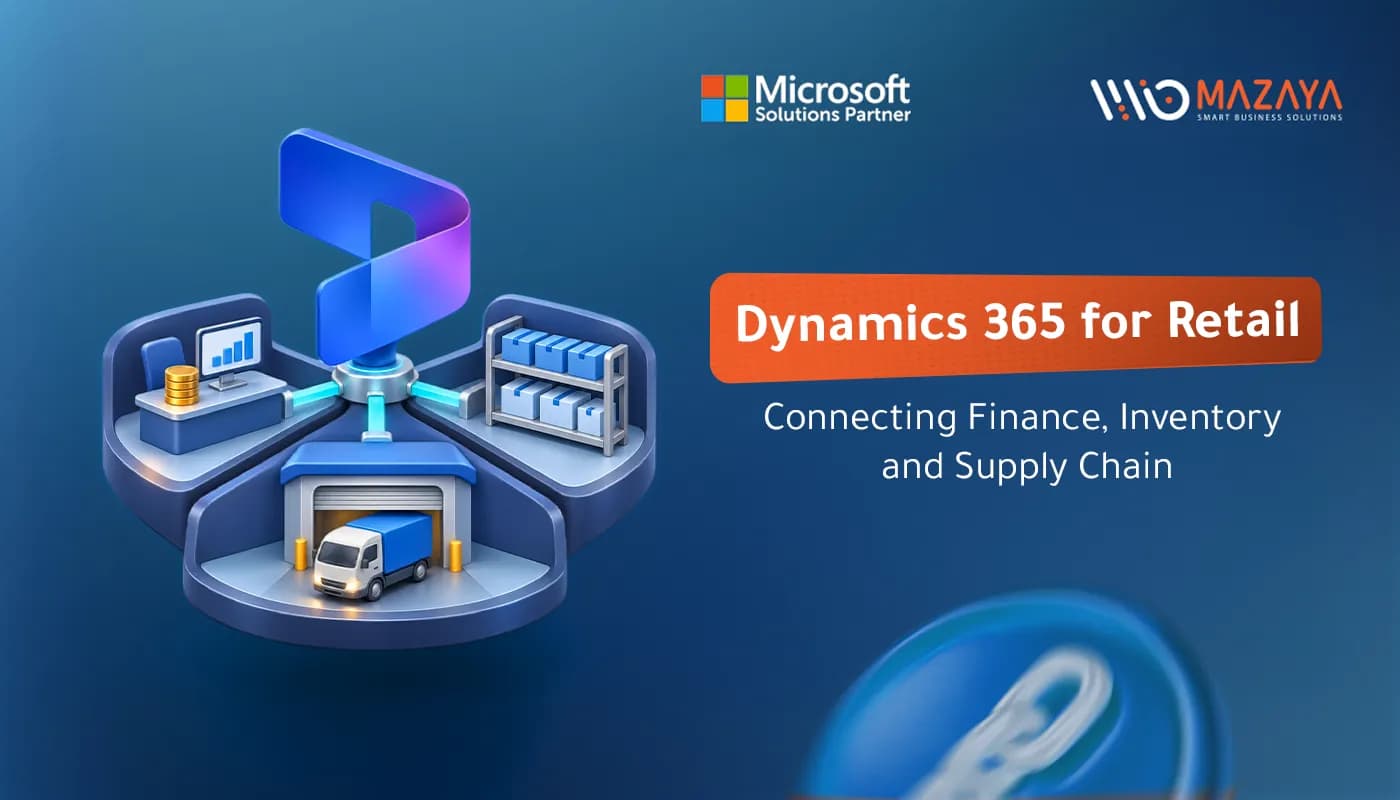
Dynamics 365 for retail is a Microsoft solution that connects store POS, e-commerce and mobile app orders to a single financial and operational core: accounts, inventory, purchasing and warehouses. The result is that your CFO and your COO work from the same numbers instead of separate reports from every branch. It is the best fit for retailers operating multiple branches, legal entities or countries.
Three questions before you start
-Can you tell right now, without calling the branches, how many units of a given item are available in each store and warehouse?
- How long does your month-end close take after the last branch submits its numbers?
- Does the stock balance in your system match what is physically on the shelves?
- If the honest answer to at least one of these is "we don't know exactly", this article is written for you.
1. How Microsoft's retail ERP works
Microsoft ERP for retail is built from two layers that work together:
- Dynamics 365 Commerce (the selling layer): captures orders from store POS, the online store and the mobile app. Example: a customer orders in the app and picks up in a branch.
- Dynamics 365 Finance and Supply Chain Management (together known as F&O): the financial and operational core covering accounts, inventory, purchasing and warehouses. Example: recording revenue, deducting stock and triggering replenishment.
The practical benefit: what a branch sells today appears in the same inventory and the same financial books, with no intermediate files and no double data entry.
What this means for each role
CFO: a unified financial framework, a faster close and clearer control over approvals.
COO: one view of inventory, orders and replenishment.
IT manager: one cloud platform instead of scattered systems that need constant integration work.
2. Unified finance across branches and companies
When a retail group operates in Saudi Arabia and Kuwait, each entity ends up with its own system, currency and files, and month-end close turns into manual consolidation. With a single financial core, the group can:
- Manage multiple legal entities and currencies (such as riyals and dinars) in one environment.
- Produce consolidated reports at branch, entity and group level.
- Apply the same approval and control policies in every branch.
Compliance in Saudi Arabia: e-invoicing (Phase 2 of the ZATCA requirements) is an operating requirement in the Kingdom, and it is not enough for a system to support it in theory. At Mazaya, during the analysis phase we work with your team to define what applies to your entity and your version of the system, then configure and test it before go-live. The same applies to the requirements of every other country you operate in, including Kuwait. (Microsoft supports e-invoicing in Finance and Supply Chain Management, and simplified invoices from POS in Commerce.)
3. Inventory and warehouses
One of the most common sources of retail losses is the gap between what the system says and what is actually on hand. A single view of inventory across branches and warehouses is where improvement starts, and it is the core of any D365 supply chain retail setup.
Quick checklist for inventory accuracy:
- Does every item have one unified code across all branches?
- Do you run cycle counts with barcode scanning instead of a single annual count?
- Do you know the status of stock transferred between branches (in transit or received)?
- Are returns recorded in inventory and in the books at the same moment?
- Is there a clear rule preventing negative stock?
A quick test: pick one top-selling item and compare its system balance with the physical count in three branches. If the results differ, that is the gap a unified platform is designed to close.
Would you like to run this checklist against your own branches? Mazaya's consultants can review it with you in a short assessment session. [Book an assessment session for your Dynamics 365 implementation]
4. Purchasing and suppliers: from real demand to the right payment
In many retail companies, purchasing starts in a manual spreadsheet and ends with an invoice nobody can confidently match to what arrived. With one system, the picture changes:
- Purchase orders start from real demand. Each branch and warehouse shows its balance and sales rate, so orders are built on data rather than estimates.
- Approval workflows follow value and category. A small order is approved by the branch manager; a large one escalates automatically to the CFO, with the same rules in every branch.
- Three-way matching protects cash. Example: a supplier invoices 500 cartons while the warehouse received only 450. The system flags the difference before payment, so you never pay for 50 cartons that did not arrive.
- Supplier performance becomes a number. On-time delivery rates and received versus ordered quantities give you a clear basis for negotiating or changing suppliers.
5. Reporting: one number everyone trusts
The real value of reporting is not volume but agreement on the source. When inventory, sales, purchasing and cost figures come from one platform, you eliminate the meeting where half the time is spent working out which file is right.
- CFO: branch profitability, cash flow and consolidated reports at entity and group level.
- COO: stock levels, items close to stock-out, replenishment and delivery.
- Teams: dashboards that users build and share, plus the ability to pull data into Excel for quick analysis.
Example: on Sunday morning the CFO asks which branches have the lowest profitability this month. The answer sits in one dashboard reading from the same books the COO uses, instead of waiting for reports to arrive from each branch in a different format.
6. From order to delivery
The value of integration is clearest in retail's hardest scenario. Illustrative example: a customer in Riyadh orders a product in the app, collects it from a nearby branch, then returns it at a different branch.
- Commerce records the order and checks availability at the requested branch.
- F&O reserves the quantity from that branch's stock.
- At pickup, the quantity is deducted and revenue is recorded in the books.
- At the return in another branch, the quantity goes back into stock and the financial entries follow.
Every step is visible to everyone in the same system, with no manual reconciliation afterwards.
7. Case study: Domino's UK & Ireland
Does this kind of integration work at scale? In a customer story published in April 2026, Microsoft describes Domino's in the UK and Ireland, a network of roughly 1,400 stores operated through franchise partners.
Important note: Domino's is not a traditional retailer. It supplies ingredients to a network of stores, and the solution described is Dynamics 365 Finance and Supply Chain Management. We therefore present it as an example of connecting finance, inventory and supply chain across a large network of locations, not as a POS case.
The challenge: an out-of-support legacy system (AX 2012) and paper-based, fragmented finance and logistics processes.
What changed, according to Microsoft:
- Finance and logistics unified on one platform, with less dependence on the IT team.
- Purchase order approval workflows under different rules, configured by the finance team itself.
- 100% paperless warehouses with real-time stock tracking on handheld devices instead of printed picking lists.
- One-touch delivery confirmation from the driver, with the invoice emailed automatically.
- Five supply chains that previously ran on separate tools brought together.
The lesson for you: the rollout was phased and backed by a change management plan. According to the story, the company maintained 4,000 weekly deliveries and 99.8% product availability during implementation, so the transformation did not disrupt operations.
Source: Microsoft Customer Stories
Does your branch network suffer from the same fragmentation? An assessment session with the Mazaya team starts from your current situation: number of branches, systems in use and the biggest problem you face.
[Book an assessment session for your Dynamics 365 implementation]
8. Why Mazaya as your Dynamics 365 implementation partner
Choosing the system is one decision; choosing the partner who implements it is just as important. These are the questions CFOs, COOs and IT managers usually ask before signing:
A team close to you in Saudi Arabia and Kuwait. Our headquarters has been in Riyadh since 2023, and we have an office in Kuwait. Analysis, training and support sessions run with a team that speaks your language and works in your time zone.
More than 20 years building enterprise systems. Mazaya was founded in 2005 and has worked with 15 ministries and more than 60 government entities, as well as companies in education, finance, real estate, food and other sectors. These clients impose strict requirements for governance, security and quality, the same standards large retailers need.
Experience across more than one Dynamics 365 solution. Mazaya is a Microsoft Solutions Partner delivering Finance & Operations, Business Central, customer relationship management and contact center. That is why our recommendation is based on the scale of your operations, not on a single product we happen to sell.
Integration with what you already run. We built MIE (Mazaya Intelligence Engine) as an integration layer that connects Dynamics 365 to other systems and government platforms, including ZATCA and Nafath in Saudi Arabia and KNET in Kuwait, instead of a web of point-to-point connections that burdens your IT team.
Security and continuity backed by international certification. We hold ISO certifications, including ISO 9001 for quality, ISO/IEC 27001 for information security and ISO 22301 for business continuity.
Support after go-live, and beyond. We stay with you after launch, and we add process automation and AI on top of the system once your data is unified and ready.
That is why our relationship starts with an assessment session that does not commit you to anything: we understand your situation first, then recommend.
9. Who Dynamics 365 for retail suits, and when it does not
It likely suits you if:
- You have multiple branches, entities or countries, and multiple currencies.
- Your current system is fragmented, outdated or dependent on manual files.
- Your warehouses, purchasing and supplier volumes make manual errors costly.
- You sell through more than one channel (stores, online and app).
Another option may fit better if: you have one or two branches with simple operations. In that case Dynamics 365 Business Central may be a better and less complex fit, and we will tell you so plainly in the session.
What matters to the IT manager: integration with your current POS and online store, the data migration path, cloud deployment, user permissions, and a phased rollout that protects operations. If you own the technical side, send us your questions about integration, data migration and permissions in advance, and we will go through them with you in a technical assessment session. [Request a technical assessment session for Dynamics 365]
Frequently asked questions
What is the difference between Dynamics 365 Commerce and F&O?
Commerce handles selling (stores, online and app), while F&O is the financial and operational core (accounts, inventory, purchasing and warehouses). They run together on connected data.
Is it suitable for a company with 10 branches?
Branch count is not the only criterion. What matters is operational complexity: the number of entities, currencies, warehouses and channels. We assess this with you in the first session.
When is Business Central the better choice?
For smaller companies with simpler branch and entity structures.
How long does implementation take?
It depends on scope: number of branches and entities, data volume and integrations. We set a clear timeline after the analysis phase.
Does it integrate with our current POS and online store?
We assess whether to keep or replace them during the analysis phase, depending on the existing system.
Does it support multiple countries and currencies?
Yes, through multiple legal entities and currencies, with localization requirements for each country defined during the analysis phase.
What should I bring to the assessment session?
The number of branches and countries, the name of your current system, and your biggest problem with inventory, financial close or reporting.
Start with an assessment session with the Mazaya team
Mazaya is an implementation partner for Microsoft Dynamics 365 solutions in Saudi Arabia, Kuwait and Australia. In the session we look with you at:
- Where your finance, inventory and purchasing data is fragmented.
- Whether F&O or Business Central is the right choice for you.
- The next possible step and where implementation should begin.
[Book an assessment session for your Dynamics 365 implementation]
We're here to help you connect with us easily
A member of our team will reach out to you shortly after you submit your information.